Coalitions of Solutions: A Competitive Federal Architecture for Sovereign Student Email
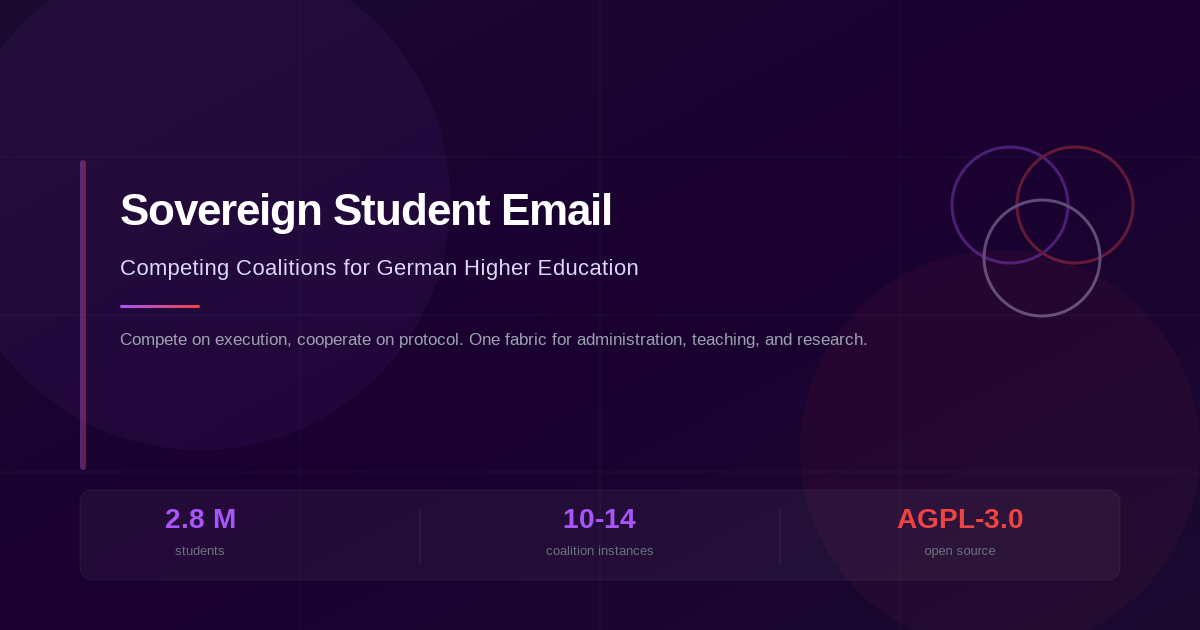
Roughly 2.8 million students are enrolled at German higher-education institutions. Each requires an email address. Most institutions provide one, but the prevailing model (individual mail servers at each of approximately 400 institutions, or outsourcing to commercial cloud providers) produces fragmentation, duplicated operational overhead, and data flows that leave student communications outside German jurisdiction.
An earlier version of this article proposed a single answer: one instance per Bundesland. We still consider that model viable, but we no longer present it as the answer. Germany is a federal democracy, and in a federal democracy not everyone jumps on the same bandwagon. Pretending otherwise produces proposals that die in committee. The healthier reading of the same constraint is that openEduSuite's demonstrated strength is building coalitions: this article therefore proposes not one solution, but several coalitions of solutions. They rest on more or less the same concept (a sovereign, open-source, standards-based email and collaboration stack) and they compete with each other in a deliberately friendly manner. And because the same fabric serves students, administration, faculty, and research alike, each coalition also strengthens cooperation across those groups rather than serving students alone. The analysis remains intentionally conservative; cost figures are given as ranges with stated assumptions, not as precise claims.
The Federal Context
Any proposal for national-scale infrastructure in German higher education must contend with a structural reality: education policy is a state responsibility (Kulturhoheit der Länder). The 16 Bundesländer hold sovereign competence over their education systems, including higher education. The federal government (Bund) cannot mandate participation, nor would such a mandate be desirable; it would conflict with the constitutional distribution of competences (Articles 30 and 70 of the Basic Law).
This shapes every aspect of the proposal:
- Governance: No federal authority can impose a unified email platform. Participation must be voluntary and organised among institutions that choose to cooperate.
- Data protection: Each Land has its own data protection authority (Landesdatenschutzbeauftragter). A nationwide operator would need to satisfy up to 16 separate supervisory authorities plus the federal commissioner. Keeping data under the jurisdiction of the coalition that operates it is simpler and more accountable.
- Procurement: Public procurement follows EU directives and national law (VgV, UVgO). Coalitions of public institutions can procure within rules their member organisations already know.
- University autonomy: Article 5(3) of the Basic Law guarantees the autonomy of research and teaching. Universities are not administrative units of their Land; they choose how they host, and any architecture that assumes otherwise is stillborn.
But the federal context also supplies a positive insight that the earlier version of this article underused: German higher education already knows how to form coalitions across Land boundaries. The Kube3 project (more on it below) is an eight-institution consortium spanning three Länder, built precisely to share a Kubernetes infrastructure while each member keeps its own governance. Coalition-building is not a hypothesis; it is the observed working mode.
Coalitions Instead of a Uniform Model
A coalition of solutions is a voluntary alliance of institutions that pool operations around one shared stack under a shared governance, without creating a new central authority. Members join because the coalition fits their situation, and they can leave along standard export paths.
What unites the coalitions proposed here is the concept:
- a sovereign, open-source stack (mail, file storage, calendar and contacts, messaging, identity) under German jurisdiction
- identity federation via DFN-AAI
- interoperability through standard protocols: SMTP for mail, Matrix federation for messaging, CalDAV/CardDAV for calendars and contacts, OpenCloud federation for file sharing, SAML/OIDC for authentication
Where coalitions differ is execution: which substrate they run on (a shared Kubernetes platform, their own clusters, or externally operated infrastructure), how they govern themselves, how broad their service palette is, and how fast they move. Those differences are not defects to be engineered away. They are the competitive surface.
One Fabric for Administration, Teaching, and Research
Student email is the entry point of this analysis, but it is not the boundary of the platform. The service palette described here serves every group of a university:
- Administration runs its daily communication, service desks, and groupware on the same stack, under the same identity infrastructure.
- Faculty teaches and coordinates on it: course rooms, seminar communication, and integration with learning-management systems such as Moodle or ILIAS.
- Research collaborates on it: project rooms, federated file sharing with partners inside and outside the coalition, and, increasingly, local AI services on the same substrate.
The sovereign-email debate is often framed as a student-infrastructure question. That framing undersells both the problem and the opportunity. Cooperation between these three groups currently runs over an incoherent collection of tools: students on one platform, administrative staff on another, research projects on a third, with identity disconnected between them. A coalition stack replaces that with one fabric: one login (DFN-AAI), one set of protocols, one operational team accountable for them. When a course project involves the service desk, or a research alliance includes teaching staff, the participants meet in the same federated rooms rather than across tool boundaries.
Coalitions strengthen this rather than weaken it. A coalition pools exactly those groups whose workflows are hard to split: administration and faculty join because their service relationships with students are daily business, research joins because its collaborations cross institutional borders that federation already handles. The result is a coalition whose membership mirrors the institution's real cooperation structure.
Three Example Coalitions
The following coalitions are examples, not a closed list, and naming them is not an endorsement of any of them.
Kubernetes-based coalitions
The clearest existing template is Kube3: a cross-state collaboration of eight universities and research institutions from Baden-Württemberg, Bavaria, and North Rhine-Westphalia (Karlsruhe Institute of Technology, Heidelberg University, University of Tübingen, Leibniz Supercomputing Center, University of Bamberg, RWTH Aachen University, University of Münster, University of Cologne). Kube3 builds a federated Kubernetes-as-a-Service infrastructure across the participating sites, with deliberately heterogeneous underlying platforms and a common experience at the service layer (project description by RWTH Aachen, announcement by the Digitalverbund Bayern, project page at Heidelberg University). The project runs from 2025 through 2027/2028 and tests concrete services on the shared infrastructure.
For the openEduSuite community, this is the natural first coalition: the community's deployments already run on Kubernetes clusters operated by university computing centres, and a KaaS coalition such as Kube3 provides exactly the substrate such a stack needs. University AI initiatives are the second natural partner, discussed next.
AI initiatives at other universities
Several universities have built or are building AI capacity under their own governance: local language-model services, GPU clusters, and the engineering teams that operate them. These initiatives exist for the same sovereignty reasons discussed in this article, and they already possess what an email coalition needs most: infrastructure competence and sustained funding. Extending an AI platform with mail, collaboration, and identity from the same open-source palette is a comparatively small operational step, and it produces another coalition with the same concept and a different profile.
Migration to other providers
Some institutions will not join any in-sector coalition. They will migrate to externally operated infrastructure: sovereign cloud offerings or specialised providers of open-source collaboration stacks. In the model proposed here, that choice is legitimate and not a failure. A provider-operated coalition competes on the same terms as an in-sector one, provided it honours the same standards and export paths. Compatibility, not uniformity, is what the concept requires.
The Award-Winning Triad as Coalition Components
In October 2026 the ideas competition on digital sovereignty of the Hochschulforum Digitalisierung (HFD), the digitalisation think tank of German higher education, run jointly by Stifterverband, CHE, and the Hochschulrektorenkonferenz (HRK), selected three winners from 19 submissions: openEduSuite, the infrastructure base described in this article; GenAI@KIT, an innovation space for generative AI at the Karlsruhe Institute of Technology; and LLMduckt, per-person API access to AI language models for teaching at Graz University of Technology. The triad is the coalition model in miniature: an infrastructure layer, an AI services layer, and a teaching integration layer of the same concept, developed at three universities in two countries, and none of them presented as the single answer.
The projects integrate along four lines:
One identity. The Keycloak single sign-on, federated via DFN-AAI, gives every project the same account model. A student authenticates once, and the same identity fronts the mailbox, the collaboration spaces, and course-scoped AI keys. Key distribution in the LLMduckt pattern hooks into the learning-management system; access rules in the GenAI@KIT pattern hook into institutional identity. For both, the coalition fabric turns account management into configuration rather than a new account system.
One substrate. openEduSuite packages its services as Kubernetes-native components deployed with Helm. That makes the platform a natural landing zone for the other two projects: an AI service developed in the GenAI@KIT pattern and a key-distribution component in the LLMduckt pattern land in the same service catalogue as mail and collaboration, and a Kubernetes-as-a-Service coalition such as Kube3 can host the entire triad for its members.
An AI gateway with governance. GenAI@KIT contributes a responsible-use framework and the model-serving infrastructure; the LLMduckt pattern contributes per-course, per-student key distribution with lecturer-chosen models. Combined on one fabric, they form an AI gateway that respects the group boundaries described above: administration uses governed assistants, teaching receives auditable keys per course, and research accesses raw interfaces under its own data-protection rules. Three groups, three relationships with the AI layer, one login.
A sovereignty chain from mailbox to model call. The collaboration fabric keeps communication and documents under the institution's jurisdiction; local AI services keep prompts there; per-person keys make usage attributable and auditable. The chain closes end to end: no step of the daily work of students, staff, or researchers has to leave the coalition's fabric.
The triad also validates the pluralism thesis from an unexpected direction. The jury did not select one uniform solution; it selected a foundation, an AI programme, and a teaching integration from three institutions, and its announced plan of connecting the winners with partners from its network is coalition formation in miniature. For a university considering an email coalition, the takeaway is concrete: the components this article proposes to run on the fabric exist, they were selected by an independent jury, and they come from the same community of universities the model addresses.
Friendly Competition
The model in one sentence: compete on execution, cooperate on protocol.
The interoperability profile is not up for competition. Every coalition speaks SMTP, federates via DFN-AAI, opens Matrix rooms across coalition boundaries, shares calendars over CalDAV, and exchanges files over OpenCloud federation. This is the layer where uniformity matters, and it is kept deliberately thin.
Everything above that layer is contested:
- Operational quality: filter precision, delivery latency, uptime, and how quickly incidents are resolved.
- Migration tooling: how painlessly an institution can move in, and how easily it could move out.
- Feature depth: which collaboration services a coalition layers onto the shared mail core.
- Cost transparency: published, comparable per-student figures instead of opaque bundling.
- Cross-group workflows: how well a coalition supports cooperation across administration, teaching, and research, from mixed collaboration rooms to learning-management integration and service processes.
- Student experience: what a student actually notices, from webmail quality to how the platform handles their first week.
Three mechanisms keep the competition friendly. First, no lock-in: data export via standard protocols is always available, so leaving a coalition is a process, not a hostage situation. Second, shared security: reputation feeds, MTA-STS policies, and DKIM/DMARC monitoring serve all coalitions alike, because threat intelligence hoarded is threat intelligence wasted. Third, open measurement: coalitions publish their operational figures and compare them in regular benchmark meetings rather than in marketing material.
Why pluralism instead of uniformity? Uniformity concentrates operational and political risk in a single governance; pluralism distributes it. Uniformity must persuade all 16 Länder before anything ships; pluralism lets the first coalition start and lets the others learn from published evidence instead of opinion. And a permanent exit option disciplines every operator far more effectively than a master plan ever could. It is the market mechanism transplanted into public infrastructure, minus the lock-in that normally accompanies it.
The Shared Backbone
Coalitions need a neutral layer they all stand on, and the DFN (Deutsches Forschungsnetz) already provides it: the national research network, the DFN-AAI identity federation, and established coordination formats. In this model the DFN stores no mailboxes. It provides the connective tissue: network, identity federation, shared security services (DNSBL reputation, MTA-STS policy distribution, DKIM/DMARC monitoring, threat-intelligence sharing), and a forum where the interoperability profile is maintained and conformance is tested. A referee, not a competitor.
Coalition Instances
Each coalition operates one or more instances sized for its member institutions' students. An institution within a coalition operates as a tenant, with its own domain, user management, and administrative policies; institutions that prefer full control can run the same open-source stack on their own hardware and federate with their coalition and beyond it. Small coalitions can pool resources with neighbours. The number of operational instances is not fixed by policy: on the order of ten is a realistic assumption for a country of this size, and the exact count is an outcome of coalition formation, not an input.
Cost Estimate
The estimates are deliberately conservative, with ranges reflecting uncertainty in hardware pricing, staffing, and storage allocation. They cover coalition instances plus the shared backbone, not a single central deployment. Per-instance figures are unchanged from the earlier version of this article; only the framing has moved from Land instances to coalition instances.
Per Coalition Instance (3-Year TCO)
| Component | Lower bound | Upper bound |
|---|---|---|
| Hardware (mail, collaboration, storage, control plane) | €80,000 | €150,000 |
| Colocation and connectivity | €45,000 | €90,000 |
| Operations (0.5–1 FTE, shared with existing institutional or Land IT) | €120,000 | €225,000 |
| Per instance (3 years) | €245,000 | €465,000 |
Shared Services (Backbone, 3-Year TCO)
| Component | Lower bound | Upper bound |
|---|---|---|
| Security infrastructure (shared DNSBL, MTA-STS, monitoring) | €100,000 | €200,000 |
| Coordination, standards, and development (3–5 FTE) | €675,000 | €1,125,000 |
| Shared (3 years) | €775,000 | €1,325,000 |
Aggregate Scenarios (3-Year TCO)
The number of coalition instances is an assumption here, not a plan. Scenarios assume ten, twelve, and fourteen instances.
| Scenario | Total (3 years) | Per student per month |
|---|---|---|
| 10 instances, lower bound | ~€3.2 million | ~€0.03 |
| 12 instances, central estimate | ~€5.3 million | ~€0.06 |
| 14 instances, upper bound | ~€7.8 million | ~€0.08 |
These figures assume an email-focused deployment (1 GB/student). Including collaboration storage at 10–20 GB/student would increase storage costs substantially. Migration, training, and integration costs are not included.
For comparison, current aggregate spending is estimated at €40–80 million per year across roughly 400 budgets. The coalition model represents a significant reduction in aggregate infrastructure cost, though the comparison is imperfect: current spending includes institutional overhead that consolidation reduces but does not eliminate. The per-student cost of roughly €0.03–€0.08 per month is two orders of magnitude below typical commercial cloud licensing, which reflects the commodity nature of email at scale. The dominant cost is coordination, and pluralism does not change that; it only distributes the coordination across coalitions that have a genuine stake in getting it right.
Technical Foundations
The components are in production use today:
- Stalwart Mail (AGPL-3.0): a Rust-based mail server providing IMAP, POP3, SMTP, and JMAP with native full-text search.
- OpenCloud (Apache-2.0): file storage, sharing, and collaboration.
- Matrix/Element (AGPL-3.0): federated messaging.
- Keycloak (Apache-2.0): identity and access management, SAML/OIDC.
- Additional components for calendar, contacts, and video conferencing, deployed via container-native packaging (Kubernetes, Helm) and configuration management (Ansible).
The mixed licences (AGPL-3.0, Apache-2.0, MPL-2.0) reinforce rather than undermine sovereignty: modifications distributed over a network must be shared, which prevents private forks from undermining the commons. Just as important for this model is portability: the palette runs on a KaaS coalition's platform, on an AI initiative's existing cluster, or on provider-operated infrastructure with the same configuration interfaces. That portability is what makes coalitions substitutable and competition real rather than rhetorical.
Governance
- Each coalition governs itself: admission, service palette, and operations are coalition decisions under the data protection authority of its members, with administration, faculty, and research represented in the coalition's governance.
- The DFN provides shared services and hosts the interoperability profile in its existing neutral role.
- A coordination body with representatives from every coalition, from the DFN, and from the domains the coalitions serve (administration, teaching, and research) maintains the interoperability profile and organises the benchmark meetings. It runs no instances and favours no coalition.
- Funding combines member budgets, voluntary institutional contributions, and, if available, federal start-up financing through a Digitalpakt-style mechanism under Article 104b of the Basic Law (the Bund finances, the Länder execute). The existing Digitalpakt Schule applies to schools; a comparable instrument for higher education would need to be established or an existing funding line repurposed.
Participation and exit remain voluntary at every level. No institution is compelled to join a coalition, and data export via standard protocols is always available.
Open Questions and Limitations
- Coalition formation. Who convenes the first coalition, and which institutions join? Kube3 shows that cross-state consortiums are fundable; whether one of them adopts a student-email use case is an open political question.
- Conformance testing. The interoperability profile needs an executable conformance test suite, published per coalition, so that compatibility claims are verifiable rather than asserted.
- Address portability. Email addresses outlive platforms. Whether a student's address follows them across a coalition change (via aliasing or forwarding policy) needs a common agreement that goes beyond SMTP.
- Data protection across coalitions. Metadata (routing, calendar sharing) crosses coalition boundaries. A data protection impact assessment under Art. 35 GDPR should evaluate federated metadata flow before any pilot.
- Provider-operated coalitions. What sovereignty requirements must an externally operated coalition meet, and how are they audited? This needs a concrete criteria set before the option is offered to institutions.
- Cost validation. The figures rest on component benchmarks extrapolated to coalition scale. A proof-of-concept (for example, 5,000 simulated mailboxes over 30 days) would validate capacity assumptions and surface operational edge cases.
Conclusion
A sovereign, federated email and collaboration platform for German higher education is technically feasible and economically plausible. The earlier version of this article argued for one uniform federal model. This version argues for something the federal context makes more honest: several coalitions of solutions, resting on the same concept, competing on execution and cooperating on protocol, with the DFN as the neutral layer beneath them and no institution forced onto any bandwagon. And because every coalition carries administration, teaching, and research on the same fabric, each one also deepens the cooperation between the groups that make a university a university.
Pluralism here is not a concession to reality. It is the design. It matches the constitutional order, it matches the observed behaviour of German higher education (Kube3 exists; AI initiatives exist; provider migrations exist), and it produces evidence instead of standstill. What remains is coordination: convening the first coalition, writing the conformance tests, and comparing results in the open. The technology is ready. The coalition-building skill demonstrably exists. The next step is a conversation, possibly several in parallel.
Next Steps
- Evaluate the stack. The open-source components can be deployed from Ansible playbooks on a single node for evaluation.
- Study the existing coalitions and the award-winning triad. The published material on Kube3 and on university AI initiatives shows what cross-institution infrastructure coalitions already do well and where they struggle; the HFD-winning projects (openEduSuite, GenAI@KIT, LLMduckt) demonstrate how an infrastructure, an AI services, and a teaching integration layer already compose.
- Discuss with coalition candidates. Computing centres considering a coalition, whether Kubernetes-based, AI-initiative-based, or provider-operated, can compare their assumptions against the figures above.
Federation is not centralisation. It is cooperation without surrender, and competition without lock-in.